Range Repair
Viking Range Burner Clicks But Will Not Light
Endless clicking with no flame is a Viking sealed burner sparking at an electrode that cannot find gas, not a failed range. The four causes in the order they turn up, and the checks an owner can do first.
- Written by
- Hollis Yamada
- Specialism
- Service technician — refrigeration and cooking
- Years in practice
- 21
- Holds
- EPA Section 608 certified
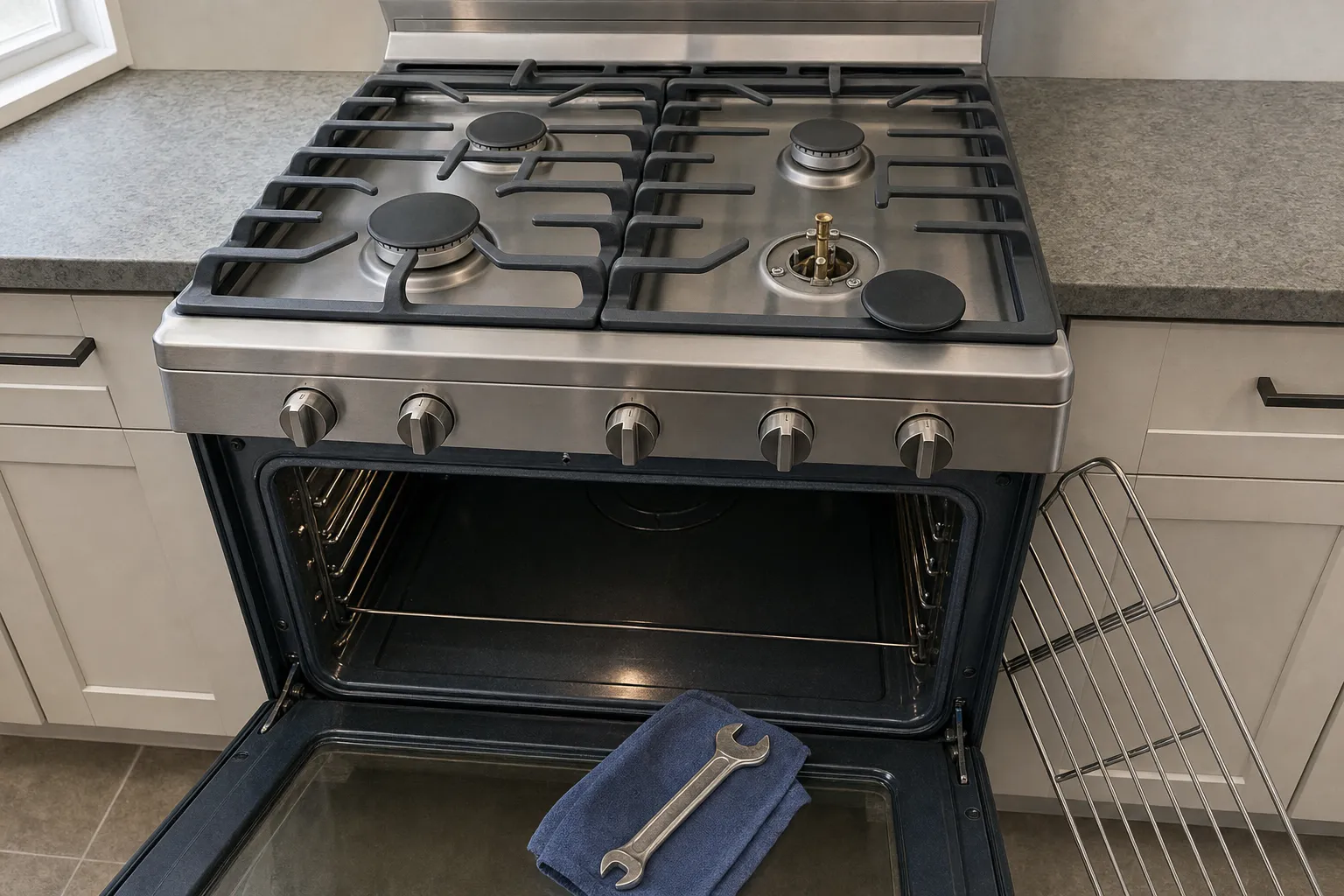
Endless clicking from a Viking sealed burner that never catches is one of the most common calls we take in Edmonds, and it is also one of the most over-diagnosed. The clicking is not a failure noise. It is the range doing exactly what it was built to do — throwing a spark at the electrode — and the question worth answering is why that spark is not finding gas.
What the clicking actually is
Every sealed burner on a Viking cooktop has a ceramic-sheathed electrode sitting in a small well beside the burner head. When you push and turn the knob, a switch behind it closes and the spark module starts firing high voltage at that electrode, several times a second. At the same time the valve opens and gas begins flowing out of the burner ports.
The spark has to jump a gap of a couple of millimetres from the electrode tip to the nearest grounded metal — normally the burner cap — and that jump has to happen where there is gas. Three things therefore have to be true at once: the electrode must be clean and dry, the burner cap must be seated and grounded, and gas must actually be reaching the ports.
Continuous clicking with no flame means one of those three is missing. It very rarely means the range is finished.
The four causes, in the order we find them
A wet or fouled electrode. By a distance the most common. Something boiled over, ran down into the electrode well and left a residue. Sugar is the worst offender because it carbonises into a conductive crust, and once the ceramic insulator is coated the spark tracks down the side of it instead of jumping the gap. The clicking is loud and the flame never arrives.
A misaligned or wet burner cap. The cap has to sit flat in its recess. If it was put back at an angle after a clean, or if water is trapped underneath it, the ports sit misaligned with the electrode and the spark fires into the wrong place. Caps also warp slightly after years of thermal cycling.
Blocked burner ports. The small drilled holes around the burner head clog with carbon and food debris. Enough of them close and the gas that does emerge is nowhere near the electrode when the spark fires.
A failing spark module or ignition switch. This is where the real electrical faults live, and it accounts for a much smaller share of calls than most people expect. The module is a potted electronic box, usually under the cooktop, and it degrades with heat and moisture rather than failing outright.
What you can check safely yourself
None of the following requires tools beyond a torch, a toothbrush and a dry cloth, and all of it is worth doing before anyone is called out.
- Turn the burner off and let everything cool. Lift the grate, cap and burner head off — they lift straight out on a sealed-burner Viking.
- Look at the electrode. If the white ceramic is discoloured, greasy or crusted, clean it dry with a toothbrush. No water, no solvent, no abrasive. The tip should be bright metal and the ceramic should be white.
- Check the burner ports with a torch. Clear any blocked holes with a straightened paperclip, never a drill bit or anything that could enlarge them.
- Dry the well underneath thoroughly. If liquid ran in, it may still be sitting there. Give it an hour with the parts off if you are unsure.
- Reseat the cap squarely and try again. If it now lights, the fault was mechanical and you are done.
The same electrode-and-cap look belongs in the once-a-year kitchen check, before a spill has time to crust.
The owner’s list stops there. Never put a flame to a burner that has been releasing unburnt gas: on the visit the technician establishes whether gas is reaching the ports before touching the ignition circuit, and that reading is what separates a gas-side fault from an electrical one.
When it is the spark module, not the igniter
There is a specific pattern that points at the module rather than a dirty electrode, and it is worth recognising because it changes the repair entirely.
The module is suspect when the clicking carries on after the burner has lit, when it starts on its own with every knob in the off position, or when it stops happening on the burners that were previously fine and moves around the cooktop. Any of those means the module is either being told a switch is closed when it is not, or has lost the ability to sense that ignition has succeeded.
The other classic module symptom is a range that ignites reliably from cold and then refuses to relight once the oven below has been running for an hour. Heat soak is pushing a marginal component past its limit. That one is almost always diagnosed as intermittent and dismissed, and it is exactly the fault where watching the appliance through a full cycle earns its keep.
Ignition switches fail more locally: one burner clicks continuously, or one burner never sparks at all while its neighbours are fine. A meter across the switch settles it in a couple of minutes.
Whether it is worth putting right
It almost always is. A cleaned electrode costs nothing. An igniter or electrode assembly is an inexpensive part and a straightforward swap. Even a spark module — the priciest item on this list — is a fraction of what a professional range costs to replace, and the burners, grates and chassis around it will outlive several rounds of electronics.
The point to stop is when you are considering buying parts on a guess. Electrodes, switches and modules produce overlapping symptoms, and replacing the wrong one leaves you with the same clicking and a part you cannot return. A meter across the switch and a spark test at the electrode separates them in under half an hour — the first two readings taken on a Viking range repair visit.
Asked about this note
- Is it safe to keep trying the burner while it clicks?
- Only for a few seconds at a time. If there is no flame after about five seconds, knob off, give the unburnt gas a minute to disperse, then one more attempt. Long, repeated tries let gas collect round the cooktop, and that is the one genuinely dangerous part of this fault.
- Why do all the burners spark when I turn on only one?
- That is normal on most Viking sealed-burner cooktops. One spark module feeds every electrode, so a single switch closing fires all of them. It only becomes a symptom when the clicking continues after the burner has lit, or starts with every knob off.
- What does the technician establish first?
- Whether gas is reaching the ports at all. That answer splits the fault in two: if the gas side is sound, the trouble lives in the ignition circuit — electrode, wiring, switch or module — and that is where the meter goes next. It is settled on the visit, not by the owner.
- Can a spilled pot really cause this?
- Yes, and it is the single most common cause we see. Liquid tracks into the electrode well, and once the ceramic insulator is damp or crusted with sugar the spark takes the easy path to the burner cap instead of jumping the gap where the gas is.